Plots in Segovia - buy, sell or rent easily

Find plots by category in Segovia (Province)


Plots for sale with most wanted features
- Urban 27
- Developable 10
- Non developable 18


Latest publications of land and houses for sale in Segovia (Province)





 +1
+1


 +3
+3
 +1
+1



Where to buy land in Segovia
With more than €60/m², Segovia has one of the highest average urban land values in Castilla y León. Building plots have a similar situation because they are concentrated in the same areas as the urban area. Meanwhile, the municipalities with the cheapest land for sale are: Fuentidueña, with €0.50/m²; Villagonzalo de coca, with €0.70/m²; Turégano, with €0.90/m²; Riaza, with €1.10/m²; and Castillejo de Mesleón and Navas de San Antonio, with €1.50/m². This is due to the great availability of rustic properties in the region.
On the other hand, various towns in Segovia have urban plots for sale that are more expensive than the provincial capital itself. They are: El Espinar, Villeguillo, Tabanera del Monte, Valverde del Majano, Navafría, Montecorredores and Ortigosa del Monte.
One of the highest values in Castilla y León due to its proximity to the capital of Spain
The province of Segovia is located to the north of the Central Plateau of Spain, to the southeast of Castilla y León. It has an area that exceeds 650,000 hectares, which represents more than 7% of the total autonomous community. The differences in altitude of its varied relief generate a climatic diversity that presents cold winters and hot summers. In addition, rainfall is irregular, being more frequent in spring and autumn. The climatic factor is very important in the Segovian territory since it is an eminently agricultural place.
A geographical relief that favours the exploitation of the land
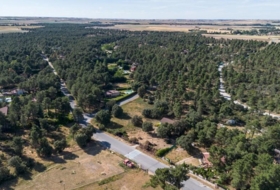
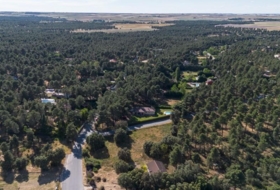
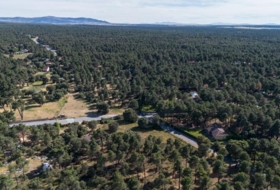
The Segovian landscape, with more than 590,000 hectares of rustic land, is made up of three main reliefs: mountains, plains, and valleys. Most of the territory is covered by an extensive plain, which has an average altitude of 900m.
Segovia is a place of agrarian tradition. It has an area that exceeds 250,000 hectares destined for agricultural exploitation, where cereals and livestock stand out. The vineyards are also of great importance, occupying a large area of land and registering a large volume of production. In the cultivation of cereals, barley and wheat predominate. For its part, the most relevant livestock is sheep, cattle, pigs and poultry.
The forest land has an extension that exceeds 180,000 hectares, which represents more than 25% of the total territory. This is a very important area for the province since logging is the main point of support for the resin, flour, furniture, and plastics industry.
The southeast of the province brings together the municipalities with the largest urban territory
The majority of Segovian municipalities are characterized by their small size and low population. However, this phenomenon varies in the southeast of the province, where the territory of the localities and the population index increase, due to the proximity to the Community of Madrid. In its totality, the urban area occupies more than 10,000 hectares, while the developable land covers more than 12,000 hectares. Residential land grows hand in hand with the population, concentrating in the southeast.
A developing industry
The metropolitan area of Segovia concentrates on the main industrial estates, which has a developing industrial fabric. And it is that it presents/displays a series of problems that breaks the industrial consolidation of the zone. Among them, the main drawbacks are depopulation, lack of adequate infrastructure, improvement of necessary basic supplies and lack of entrepreneurship. Even so, it has outstanding sectors that have some relevance at the national level. The agri-food industries, extractive mining, the energy sector, wood, and cork stand out.
Segovia, a place with a strong tradition greatly influenced
It presents some very interesting aspects of the possibility of investment. It is a territory that has a privileged geographical location and has a traditional and developed agricultural sector. Its proximity to the Community of Madrid has several benefits and drawbacks. And it is that it causes that most of its population is concentrated in the southeast. This fact results in a higher population index and a greater demand for land, which generates one of the highest average land values in Castilla y León. In the rest of its territory, most municipalities are characterized by their small size, caused by the phenomenon of depopulation. For its part, the industry benefits from its proximity to the capital of Spain and has several nationally recognized sectors. However, it is under development.